
FAQ - Questions I asked myself along the way
This post is quite long.
For more severe people, I wrote 🖤 Short answers.
Each question also has an 🔈 Audio version.
1- Will I ever feel like myself again?
2- How can I start believing that recovery is possible and deal with doubt?
3- Where do I even start?
4- What am I actually supposed to do?
5- How often should I practice?
6- Is the goal to feel calm all the time?
7- Do I still need pacing if I'm doing mind-body work?
8- Is it okay to combine medication and mind-body work?
9- How to practice acceptance when the suffering feels overwhelming?
10- My recovery is really slow and up-and-down, am I doing enough?
11- Which external resources have helped you?
12- Should I still wear a mask?
1- Will I ever feel like myself again?
I believe it is absolutely possible! I thought for a long time that my mental clarity and my capacity to live normally were gone forever... but I was wrong. I found my way back to myself and I feel at peace now. Don't lose hope.
For a long time, I thought I would never feel like myself again. That I would not be able to think clearly or shower every day ever again. Even vizualizing myself healthy in my mind became impossible.
As I'm writing this post, I'm still not 100% recovered physically, but I do feel like myself again and I enjoy my life. I have good days and bad days… like every human being. I feel at peace, and I trust my body (much more than before Long Covid).
You're going through a lot, doing the best you can, but you're not lost. I know it requires a bit of blind faith at first, but I believe our true selves are still here, under the suffering. Don't loose hope.
2- How can I start believing that recovery is possible and deal with doubt?
- Watching recovery stories (you can find some right here)
- Gaining knowledge about the nervous system
- Keeping an evidence list of my improvement and trusting myself
- Being aware of "negative" content consumption about the illness
Believing that recovery is possible is important, but doubt is also part of the process, and it will come and go. I certainly doubted often!
In the beginning, what helped me the most to build the belief was watching recovery stories (you can find some right here) and learning about the nervous system. Over time, I saw that people really do recover, from all kinds of symptoms, even really severe and long-lasting ones. It helped me realize my case wasn't unique, and that I could be one of them.
Slowly, I needed those stories less. My belief started to grow from my own experience. I keep an "evidence list" of my progress, with big and small wins (and lots of emojis 🎉 😃 🌳 🖤). I come back to it often, especially during dips, when it's easy to lose sight of how far you've come.
I don't believe in God, so I relied on my faith in the Universe and nature. I chose to trust that I was on the right path.
When doubt is stronger, I find it useful to look at what kind of content I've been consuming lately. I noticed that reading a lot about symptoms, hopelessness and descriptions of suffering affected my own state a lot.
3- Where do I even start?
Learning about the nervous system was my first and most important step. I really liked the audiobook "Breaking Free" by Jan Rothney, as it gives a strong and clear starting point!
I think learning is the first step. Before even thinking about doing things, understanding what was going on in my body removed 90% of my fear, gave me hope, and a trajectory. Practices will likely not help much if we don't understand why they are supposed to help.
I feel there is also a big difference between "understanding" (the intellectual process) and "trusting" (being convinced and feeling it in your body). At first, I only had understanding. Building trust took time: continuing to listen to different people explaining the same concepts in different ways helped me a lot.
If you feel lost in all the information available out there, my recommendation would be to read the first couple of chapters of the book "Breaking Free" by Jan Rothney (I used the audiobook version, which is very soothing). It has all the explanation you need to understand this path to recovery.
More about my detailed recovery process right here!
4- What am I actually supposed to do?
There is no one-size-fits-all recovery plan. Healing tends to happen in layers. Regulation and soothing practices (e.g. breathing, meditation...) can be helpful at first. Then, deeper inner work may unlock further layers (reaction to symptoms, patterns, emotions...)
If I learned ONE thing from the hundreds of stories I heard, it is that there's no one-size-fits-all plan. There is no single practice or program that will work the same for everyone. It's both difficult to accept... and good news, because it means you can build the path that will work for you and your specific needs.
Basic practices like breathing techniques, guided meditation and yoga nidra can be helpful to calm the nervous system in the beginning, because you can't retrain your system if it is on fire.
But once you feel more stable, you will gain capacity to do deeper work about things that can be root causes for you: reaction to symptoms, beliefs, unhelpful patterns, repressed emotions, trauma healing, boundaries...
One thing I realized during my own journey is that recovery happens in layers. Each layer unlocks more capacity, and it may require different tools, used at the right time. When I first heard that, I was desperate, and I just wanted to skip as much steps as possible... But it happens that there's no rushing this process.
In the end, things unfolded more naturally than I expected. I didn't need to solve everything at once. As I slowly moved forward, the next puzzle pieces appeared on their own, one by one.
5- How often should I practice?
At first, I pressured myself to "work" on healing constantly and perfectly. But in the end, "doing more" was not the way out. It was more about gently supporting myself, reducing pressure, and finding small moments of joy within my capacity.
In the beginning, I tried to pressure myself into "working" on my recovery constantly. Getting better became my full time job, and I intended to do it perfectly.
But moving forward with this mindset didn't work. Forcing yourself to do a practice 100 times a day, like some programs sometimes recommend, may work for some people... but for me, it was just one more way to keep the over-achiever and perfectionistic patterns on full speed.
My recovery process was not about "doing more". It looked more like this:
- being mindful of my current state,
- cultivating more self-compassion,
- gently nudging myself in a more regulated state when needed,
- doing a practice or a meditation that I enjoy, only when I felt like it,
- focusing on finding joy as much as possible within my current capacity.
6- Is the goal to feel calm all the time?
No, the goal is not to feel calm all the time, because it's not possible! What we want is a flexible and resilient nervous system that can move between states without getting stuck in chronic stress.
The goal of recovery is not to feel calm and peaceful all the time. It's humanly impossible, and it wouldn't even be healthy!
Punctual "stress" responses are normal and needed. In order to react to actual danger of course, but some daily life situations like playing sports or feeling excited about something, require a healthy mix of sympathetic activation (what we can call "stress" for the body) and parasympathetic activation (social connection).
What we want is a resilient and flexible nervous system that can oscillate easily between states in response to our environnement, without getting stuck in chronic stress responses.
So the goal is not to "calm down" at all costs. It is to send messages of safety to your brain, even during difficult times. I found mantras very helpful:
- "Whatever happens, I can handle it" (when I am in control of the situation)
- "This is uncomfortable, but it will pass" (when I can't do anything about the situation)
You can learn more about this in the post about the polyvagal theory.
7- Do I still need pacing if I’m doing mind-body work?
Yes, I believe some form of pacing, adapted to you, is necessary. Recovery is never about pushing through, but about gradually building more trust and capacity while listening to your body's needs.
Yes, I believe we need some form of pacing, one that works for us, in order to keep the recovery process as gradual as your body needs.
Maybe the word "pacing" is not the right one for you if it has a negative load. Then feel free to replace it with whatever feels right: progress cycles, adjustment, rhythm...
I always respect my own progress cycles and listen to my body when it needs a break. This is about building trust with my own system. Recovery from these conditions is never about pushing through anything.
Over time, it is possible to build a stronger intuition about what the body actually needs in a given moment: either actual rest, or more regulation.
You can keep reading about this topic with the posts about pacing and dips & setbacks.
8- Is it okay to combine medication and mind-body work?
For me, medication and mind-body approaches can absolutely work together. Medication reduced some of my symptoms in the beginning, which opened some space for nervous system work. For me, LDN and occasional low-dose benzodiazepines were helpful, under medical supervision.
Yes, I believe medication and mind-body approaches can absolutely work together, and that you don't have to choose between the two, especially in the beginning.
Medication has been part of my recovery journey, just as mind body work. I don't think medication addresses the root cause of my illness, but it definitely helped to reduce symptoms temporarily. Being able to reduce physical and mental suffering created some breathing room for my body, which is what I needed to start getting results with mind body work.
I know we are all different and not everything works for everybody. I'm only sharing my own experience. I tried a lot of medication and supplements with little success, but two things ended up being very helpful in my recovery (under medical supervision):
- LDN (Low Dose Naltrexone):
- This one helped a few % with fatigue, PEM threshold, and brain fog. It kickstarted my progress when I was at my worst and bedbound.
- Note: I stopped taking it after 1.5 years, at a time I felt confident in my current baseline and regulation toolkit. I didn't experience any setback after stopping LDN, but I know our experiences vary.
- Benzodiazepines (very punctual use of tiny doses):
- They allowed me to deal with crisis situations, like anxiety peaks, extreme insomnia, and when I needed to do things that were way outside my baseline (like in-person medical appointments).
- It helped me during severe times, but also during the recovery phase, to build a positive first experience when I was attempting a big new expansion.
I see medication as temporary help during the recovery process, just like coping mechanisms to reduce overstimulation, mobility aids, etc. As I'm getting better, I need all of those less and less often.
I am not recommending to try or stop any medication. Benzodiazepines in particular, create high risks of addiction very quickly, and require caution.
I am just sharing my experience with strategic and controlled use of medication that helped me. Always use medication under medical supervision.
9- How to practice acceptance when the suffering feels overwhelming?
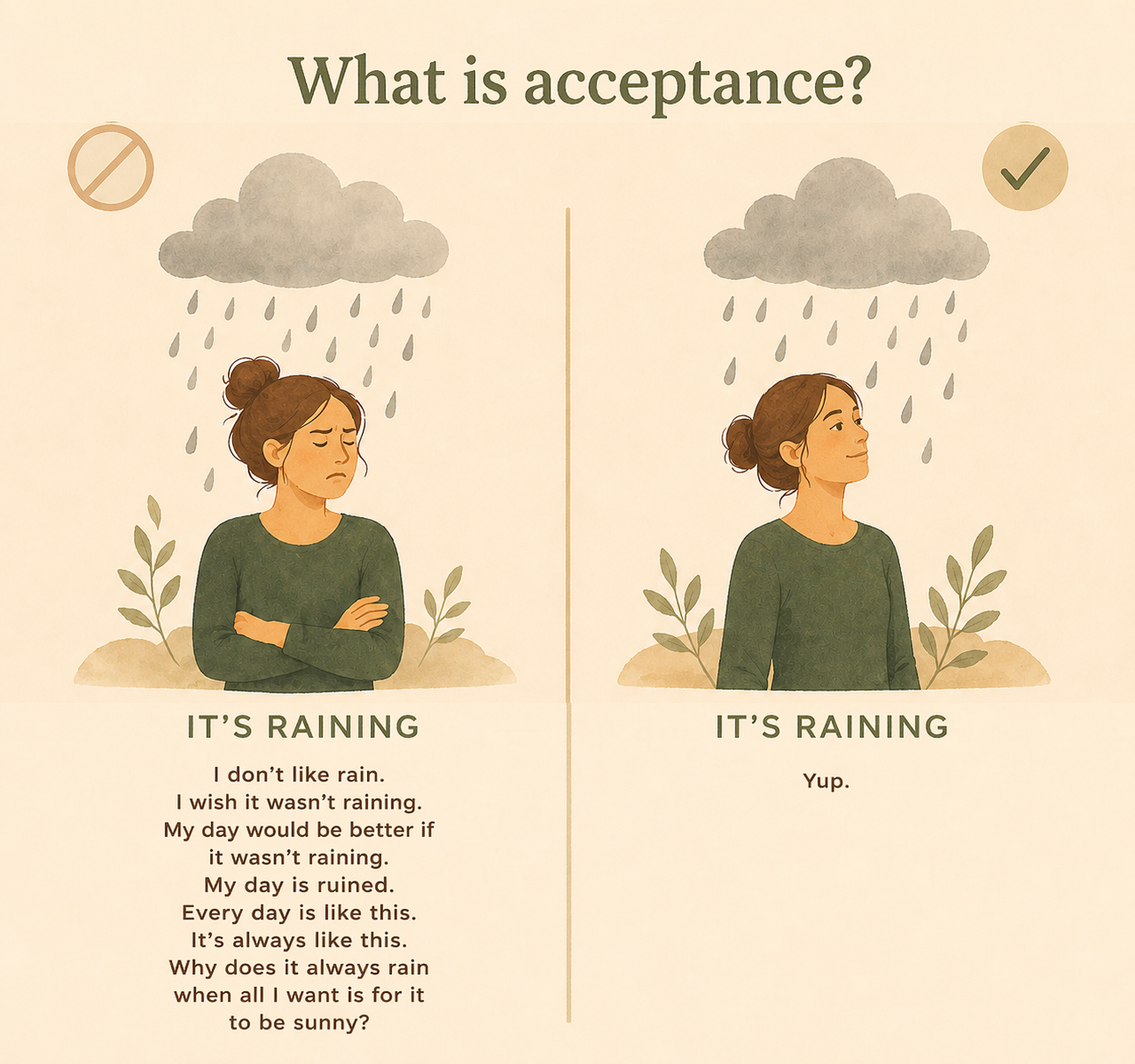
Acceptance doesn't mean giving up or saying that suffering is ok. For me, it meant letting go of what was outside my control, allowing things to be as they were for now, and not expecting symptoms to disappear immediately while still trusting that change was possible.
In healing spaces, we often hear that "radical acceptance" and "outcome independence" (= not having expectations) are needed. These concepts are tricky and can be misinterpreted (I was very confused about them too).
Acceptance doesn't mean giving up, or telling yourself that living with horrible symptoms is okay. And outcome independence doesn't mean that you don't hope for any improvement and that you engage in healing work for no reason.
To make things more relatable, I relied on three things that made sense to me:
- Letting go of things that are out of my control.
- Allowing things to be the way they are for now, without judgement.
- Not expecting symptoms to shift right away after a practice, but knowing that the suffering is temporary overall and that everything I do contributes to my healing path.
10- My recovery is really slow and up-and-down, am I doing enough?
Slow, gradual, up-and-down progress is the most common recovery pattern. Progress is often subtle, comes in various forms, and is easier to notice month-to-month rather than day-to-day.
This is the question I asked myself over and over again, and it keeps coming up every now and then.
Miracle and quick recoveries do exist... but slow, gradual, up-and-down progress is the most common experience. Progress can be very discreet, especially in the beginning. I only consider progress month-to-month, or even every couple of months. Day-to-day or even week-to-week changes will most likely be unnoticeable. You may also have plateaus and temporary setbacks.
It's difficult to accept, and it requires a lot of patience, I know. But it is not abnormal.
A good question to ask yourself when you feel like your progress is slow: how do you assess progress? There are a lot of signs of progress and recovery that we often overlook. More details in the post about signs of recovery.
11- Which external resources have helped you?
I explored various resources over two years: free content, books, paid programs, apps, coaching, support groups, and devices (details below). No single program was "the" solution for me, but many of them brought useful puzzle pieces.
Free resources & books
I listed the resources that I found the most helpful for me in this post!
Paid programs
I did several paid programs over the course of two years. Each one contained some interesting elements, but in the end, my recovery was more about picking things here and there (including many free resources) and combining them into an approach that worked for me specifically. Following one single program strictly sadly didn't work for me.
Note: Paid programs often contain a big amount of information and can feel overwhelming for people in severe states (which was my case). I never forced myself to do anything that felt uncomfortable or beyond my capacity.
Here are the programs and apps I tried:
- 4 Week Fatigue Rescue (Pamela Rose)
- Reset to Thrive (Jan Rothney)
- Curable app
- DARE app
- The Gupta Program
- Somia HEAL
Coaching
I also worked with a trauma-informed somatic experiencing practitioner for a while.
Working with someone compassionate and well-trained helped me feel more supported and less alone in the process. I think 1:1 coaching can be a good way to get unstuck too.
Devices
I tried vagus nerve electro-stimulation for a while with a dedicated device: Nurosym. It had no positive or negative effects on my symptoms, so I stopped after a few months of using it daily. It was a very expensive purchase for no results.
I also bought a device called Moonbird to facilitate breathing exercises. I enjoyed this device because the sensory aspect of it was soothing. But it is quite expensive for what it is, and you don't need to buy any device to practice breathing yourself!
Support groups
Finally, I'm incredibly grateful to the people who create and maintain 100% mind-body support groups and communities online.
Having access to free spaces filled with compassionate and knowledgeable people, sharing encouragement and lived experiences, helped me feel so much less alone and got me unstuck several times.
12- Should I still wear a mask?
This is a very personal decision. For now, I still wear FFP2 mask in indoor public spaces and use HEPA air purifiers at home. I personally feel safer reducing infections while recovering. But it's important to balance feeling safe enough, and living life, with a plan that works for you.
This is a tricky question for me, and ultimately a very personal decision. I've heard many different opinions on this topic, so I'll simply share my own perspective here.
For now, I still wear a well-fitted FFP2 (KN95/N95) mask in most indoor public spaces, and I use a couple of HEPA air purifiers at home. I see avoiding infections as a way to protect my nervous system from unnecessary strain while I'm still recovering.
Given the current state of science, I also believe that Covid remains a pretty nasty virus for anyone.
At the same time, taking precautions comes with constraints, and can sometimes increase anxiety or hypervigilance, which is not ideal for recovery either. We also can't control the behavior of other people around us.
So it's all about finding balance and a plan that makes you feel safe enough while still living your life. What you think is safe for you may evolve over time too. There's no right or wrong answer here, and other people shouldn't decide for you.
Comments