
What does a recovery day look like?
If you're new to mind-body healing, it might help to read a couple of intro posts first: My Recovery Process, and The Polyvagal Theory.
I watched countless recovery stories, completed three paid mind-body programs, and read a mountain of books. And yet, one question stayed unanswered:
"This is all great in theory… but what do I actually do each day?"
I kept wishing someone would hand me a roadmap: "Do this for X minutes, Y times a day. Rest for Z hours. If this happens, do this. Follow this plan and you'll recover." But I couldn't find anything like that. Not even someone describing what their day-to-day looked like.
I felt lost at sea without a compass.
I heard so many people say that healing paths are unique and that there's no script. But I had to experience it myself to actually believe it.
I know, this probably doesn't sound very helpful so far. 😅 So I'll share some concrete tips and I'll tell you what my recovery days looked like.
The building blocks of your recovery days
I struggled for a long time to "define my baseline" (physical, cognitive, and emotional capacity). What am I actually able to do?
Eventually I realized: my body knows. I just have to listen.
Your baseline is everything you feel 80–90% confident doing. In severe states it might not be much, and that's okay. The goal is simply to have a rough sense of what you can handle without fear.
We all have "must-do's".
Try to do something soothing before and after a mandatory task. Also consider delegating or simplifying those tasks as much as you can.
I know, asking for help is hard, but it's part of healing. And sometimes the illness doesn't give you a choice. Your body needs time and space to heal.
After trying different nervous system tools (here's a great toolbox), you probably listed a few practices that feel good in your body.
Use them whenever it feels right, not as homework. Feeling safe and enjoying the practice is more important than the practice itself.
Rest is not "doing nothing", it's a signal of safety. Sometimes rest looks like lying down with no stimulation, and other times it can look like a gentle healing practice.
If symptoms show up at any point during the day, slowing down and welcoming them with a safety signal is needed. I talk about this more in my post about setbacks.
I can’t emphasize enough how essential joy is for healing. Fill your days with as much joyful activities as you can within your current capacity. Even tiny ones.
Watching birds out the window. A conversation with someone we love. Walking in nature. Watching a good movie.
In severe states, I know joy has to be looked for on purpose, and it's not easy. But I really encourage you to do that.
Human connection is a resource but also a form of energy cost. Being around safe and positive people can be very healing, but being around toxic people is much more draining than we think. Take that into account.
There will be unexpected events, positive, or negative. Even if we try our best to create a healing "bubble around us", life still happens. Try not to anticipate disaster. If something comes up, trust that you will be able to handle it. Because you will.
These building blocks are simply here to tell you what you may encounter in your day-to-day, not to become another set of rules. Your body is your guide in this journey and the end goal is to give it what it needs in the moment.
Trust your gut
What can I do?
It took me a long time to distinguish : "Hey, I feel like I can do this!" (the voice of curiosity, confidence and calm) from : "I want to be able to do this" or "I should be able to do this by now" (the voice of pressure and despair).
If you don't know what to do at any given moment, just ask yourself:
"Within what I can do today, what do I feel like doing right now?"
The order matters. Focusing on what you can't do yet keeps you stuck in frustration. Focusing on what you can do, even if it's very small, brings you back into safety and gives you a sense of agency.
No two days will look exactly the same
Some days I can walk 2,000 steps.
The next day, I might not walk, but I can clean the house.
A few days later, I can walk 2,500.
Some days I can drive the car !
And other days, all I can do is rest or watch Netflix on the couch.
That doesn’t mean progress isn’t happening. It just means recovery is non-linear. This is why I don’t follow a pre-determined, minute by minute schedule.
Trust your instinct
If someone — a therapist, a doctor, a coach, or even family — recommends a rigid healing plan, please take it with a grain of salt. Most people are still working from old models that don’t take the non-linear nature of recovery into account.
Of course, I’m not saying to ignore medical advice. But if something doesn't feel right, trust yourself. You know your body best.
Don't get trapped in healing "work"
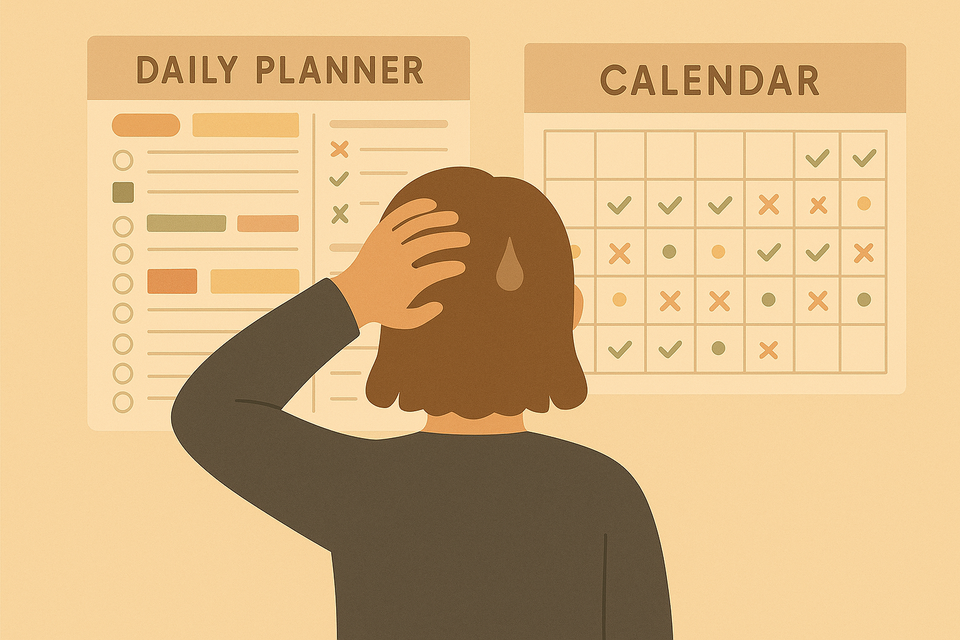
For a long time, I believed I needed a strict, detailed plan for everything in my life. Then, I realized that this was mostly coming from anxiety and a need for control. When it came to recovery, I had to do things differently. My brain desperately needed me to stop pressuring myself, and make more space for improvisation.
A plan that is too strict can become a prison.
Don't get stuck with thoughts that keep your nervous system in tension:
"I should..."
"I must..."
"This is how it's done"
"If I can't follow this program exactly, then I can't recover"
You don't need to "work" on healing 24/7. Recovery doesn't require perfection. In fact, the things that support recovery are often the ones that don't look like "work" at all.
To finish, I’d like to tell you what my days actually looked like those last two years. This is not a template to copy, but I hope it can reassure you and give you some gentle reference points.
What my own days looked like
🪫 Very severe days
- Morning
- Waking up early naturally (6 am, couldn't go back to sleep).
- Eating breakfast (food in a box next to my bed).
- Going to the bathroom and using wet wipes to wash one body area, while sitting on the toilet, if I felt able.
- Shower with my partner's help once every 1-2 months.
- Day time
- Resting in bed without stimulation (90-95% of the time).
- Eating lunch in bed.
- Turning in bed as much as I could to improve blood flow.
- Going to the bathroom around 5 times a day.
- Slow breathing for 10 minutes 3 times a day, if I could.
- A few minutes on my phone to watch funny things, on good days.
- Working with my thoughts: sending my brain messages of safety, reassuring myself that I was going to be okay, and catching anxiety spirals early
- Evening
- Eating in bed early (6 or 7 pm).
- Brushing my teeth while sitting.
- Sleep right after.
More details about what you can do to regulate your nervous system when very severe here.
⚠️ Severe days
(Just telling you what changed compared to very severe)
- Morning
- Waking up and making the bed, so I could spend the day "on" the bed and not "in" the bed anymore (this marks the difference between day and night time for the brain).
- Shower seated (once a week).
- Day time
- Breathing exercises or guided meditation session (1-2 times a day).
- Reading, watching videos, talking to my loved ones (for a couple hours throughout the day).
- Going to the kitchen (20 steps, 1-2 times a day) to grab a snack, or micro-wave a small meal for myself on good days.
- The rest of the time was still... rest without stimulation.
- I kept working with my thoughts to catch more unhelpful patterns and avoid anxiety spirals.
More details about what you can do to regulate your nervous system when severe here.
🌱 Moderate / mild days
- Morning
- Waking up, taking quite a while to feel awake (I now sleep a lot more).
- Going in the living room for the day.
- Spending time on the computer, working on the blog, doing admin tasks, or talking to people, with small breaks.
- Telehealth therapy session - CBT with a practitioner who knows Long Covid and ME/CFS (once a week).
- Day time
- Mini check-ins throughout the day: 30 seconds, pause, take a breath, hand on my chest, eyes closed. Just feeling my body.
- Cooking simple lunch and doing small chores.
- A physical activity, ideally outside, in the afternoon (walking, yoga, driving, riding my electric bike, going to the store...).
- A nap or a guided practice if I feel the need to rest/regulate.
- Evening
- Dinner with my partner (cooking together, watching a movie, talking...)
- Shower standing up (every day!)
- Reading before bed
More details about what you can do to regulate your nervous system when moderate/mild here.
It's okay if today...
... you have more symptoms.
... you allow yourself to feel discouraged.
... you find yourself doing more, unexpectedly.
... Or you can't do what you were doing yesterday.
... you need a break from healing practices.
... you have no idea what you're doing.
Recovery doesn't need to be perfect. It's made of trial and error.
Conclusion
We all hope for a clear plan. But the plan builds itself as you go. The only thing that matters is your next baby step.
Your body knows the way. Just listen, you will know what the next step is. One small decision at a time. If you keep listening, there’s actually no wrong way to do this.
One last thing I learned along the way: every time I told myself that I wasn't doing enough to recover... It was my high-achieving and perfectionism patterns speaking. What I actually needed in those moments was the exact opposite: slowing down and trusting the process.
Member discussion