
What the brain perceives as threats
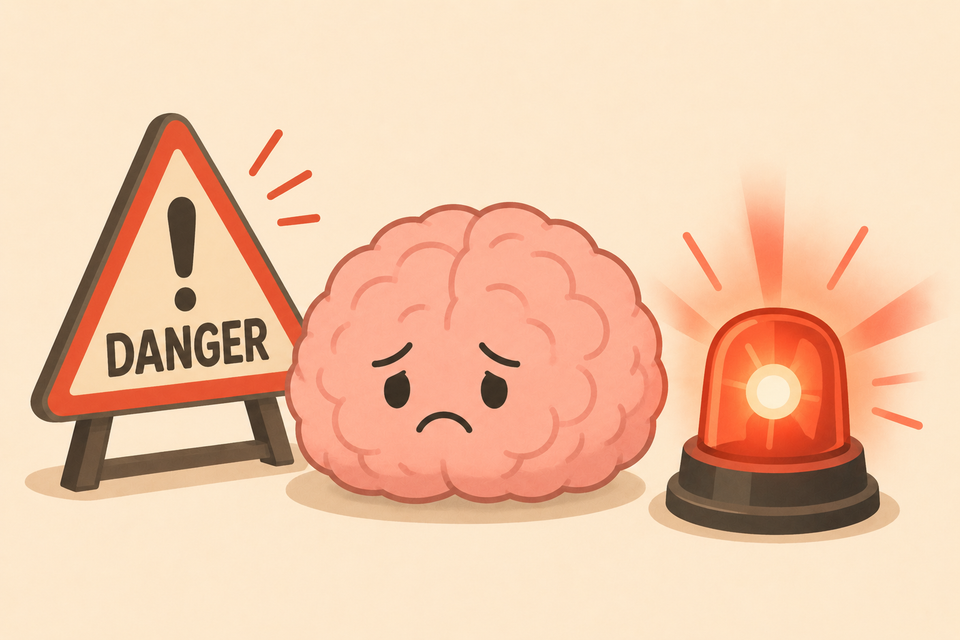
Our nervous system is built to keep us safe. It evolved to detect and react to life-or-death danger (such as being chased by a wild animal). In modern life, we rarely face that kind of danger, but our brain still reacts the same way to anything it interprets as unsafe.
What the brain can perceive as threats is not always what we expect. For me, some examples were: repressed emotions, anxiety patterns, too much exposure to negative news, and social isolation.
When these small but repeated signals of unsafety accumulate over time, we can shift into a chronic state of alert, without really being aware of it. The brain is doing its best, always adapting to protect us from too much stress. Over time, this may influence how the body functions and contribute to certain symptoms.
Noticing the things that kept my system in a chronic state of stress, and slowly working on them, made a huge difference in my recovery. So I'll share my learnings in this post.
This post may not resonate with everyone. Not all of us have the same life experiences or backgrounds. For some people, an infection, an traumatic event, or a medical intervention can be potent enough to dysregulate the nervous system all on its own. And that's absolutely valid too.
My intention here is simply to offer ideas that may help you notice some cumulative stressors in your life. Reducing stress can free up resources to help your body heal.
🪶 Take your time to read this post, it's a bit long.
Each section can be read on its own.
What can be perceived threats?
#1. Physical triggers
- Infections, injuries, surgeries...
Some events are real threats for the body at first. Then, the body heals. But for some people, the nervous system's "alert mode" remains active after the threat is gone, which can keep generating pain or other symptoms (this study explored this about chronic back pain sufferers). - Physical sensations & symptoms
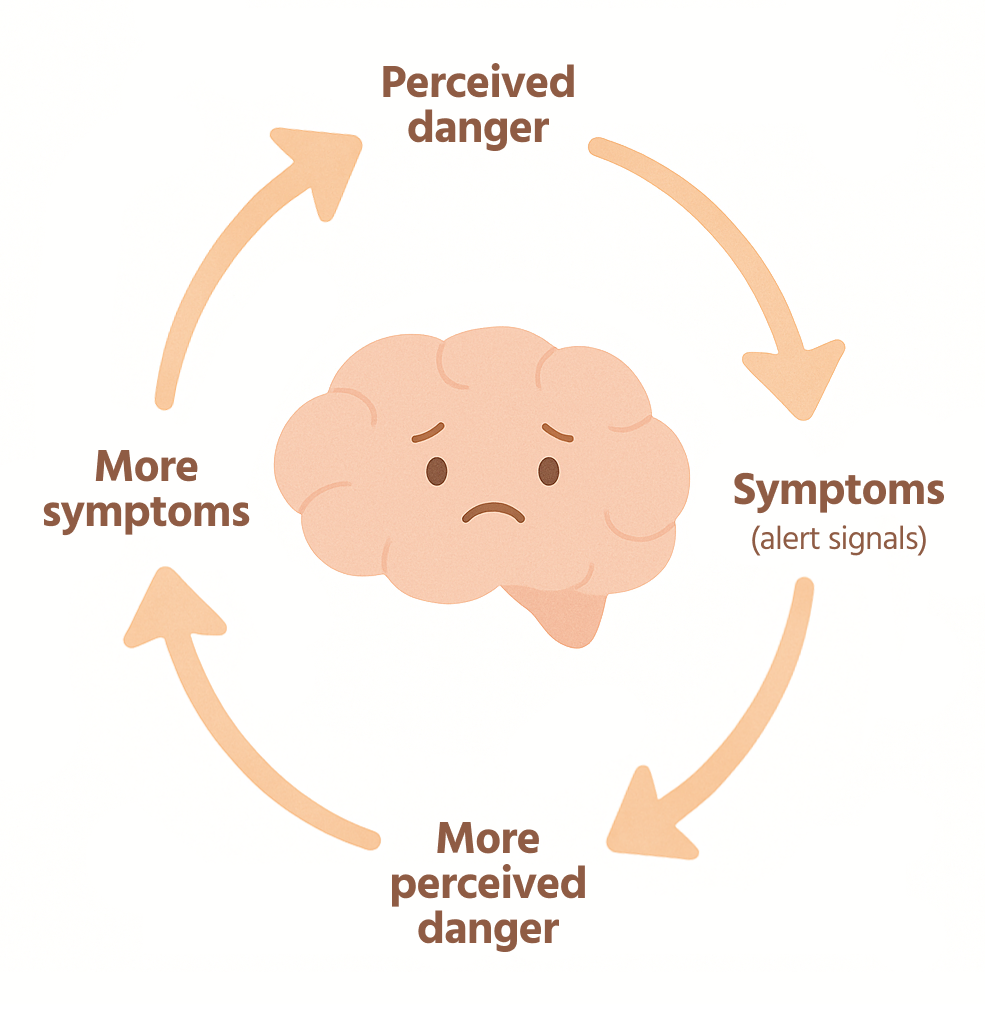
When stuck in "alert mode", the brain can misread normal sensations as danger, creating a vicious feedback loop:
- Increased sensitivities
When the nervous system is overwhelmed, it can start reacting strongly to things that were not a problem before: Mold, chemicals, allergens, electromagnetic fields, fragrances, light and sound, and even certain foods… - Life rhythms
In our societies, productivity is highly valued: being everywhere, doing everything, managing it all. Working two jobs, exercising every day, caring for loved ones, all while being a parent, a friend, a partner... I've read countless stories describing this constant race in the years leading up to illness. Over time, such a pace can exhaust the body. - Activity tolerance threshold
With Long Covid or ME/CFS, the nervous system’s tolerance threshold can drop very low. In this state, even basic daily activities can be perceived as a threat by the body. Activity itself then feeds into the feedback loop of perceived danger.
For me, the key to breaking the feedback loop was to slow down, and change my response to symptoms.
#2. Thought patterns & beliefs
This one was huge for me. Thought patterns and beliefs are often created at a young age, as a protective mechanism when we face adverse events. Over time, they can keep sending signals of unsafety to the body without us really noticing.
- Internal pressure
- Perfectionism and high achieving
All my life, I never considered what I did to be good enough. If I succeeded, it was by luck. If I failed, it was entirely my fault. I also kept pushing past my limits to achieve goals all the time.
- Perfectionism and high achieving
- Self-criticism
I became fully aware that I was extraordinarily hard on myself, and that I would never treat a friend like I treat myself! Learning to develop self-compassion was so important in my recovery. - Protective core beliefs about ourselves and about the world
- They can sound like:
"I'm not enough"
"I must perform to be loved"
"I'm weak if I ask for help"
"Something can go wrong at any moment, I must be prepared" - Gently questioning and updating those beliefs can be a great way to restore internal safety (for example: "I am enough and lovable, just as I am").
- They can sound like:
- Anxiety patterns like catastrophizing and anticipating disaster
- This one was my specialty. 😅 I had become an expert at anticipating all the ways something could go wrong. Being prepared in life is useful, but excess worrying usually doesn't do any good.
- I'm now practicing shifting this perspective with a simple sentence: "What if it all goes right?"
These patterns used to feel like part of my personality. But I realized they were actually old protection strategies, and that I didn't need them anymore.
#3. Emotions
Emotions themselves are not dangerous, but the nervous system can interpret them as threats in some cases:
- Repressed emotions
Often, anger, sadness, or fear can be repressed because early experiences taught us they were unsafe or unwelcome. Learning to feel and welcome my emotions was a big part of healing for me. Meditation about emotions and EFT tapping helped me in that direction. - Emotions like excessive guilt or shame for things that don’t deserve it can also keep the nervous system on high alert.
#4. Relationships
Much of our sense of safety comes from our connection to others, which is why relationship issues can deeply shake that sense of safety.
- Lack of boundaries & people-pleasing
I started noticing that I was often putting others’ needs before my own, rarely saying "no", even when something clearly felt too much for me. We need enough resources for ourselves before we can be there for others.
- Unsafe dynamics
Manipulative or invalidating relationships, or ongoing fears of abandonment and rejection, can be subtle but exhausting perceived threats for the nervous system over time. - Isolation
This results in a lack of co-regulation and no soothing signals from others. If you’re like me and tend to hesitate reaching out for help or comfort, it might be worth trying. Sometimes people are more open and kind than we expect.
#5. Traumatic memories
I came to understand that trauma doesn’t always come from big, dramatic events, and that not everyone will have trauma from the same experiences. I love what my coach once told me about this: "trauma can occur from too much for too long, or too little for too long".
Sometimes, things like chronic stressful situations, instability, bullying, or lack of safe and loving caregivers, can result in traumatic memories.
When the nervous system has gone through overwhelming experiences, it can stay on alert for a long time and current events can reactivate old stress responses.
#6. Modern society pressure
Some perceived danger signals come from within us, but others simply come from the world we live in.
- Constant expectations from society
Social media and advertising often contribute to the mirage of a "perfect life" we're all supposed to achieve, and this can quietly become an internalized source of pressure. - Lack of support
Communities and support systems are becoming rarer in our lives, even as expectations keep increasing. - Performance pressure
In our societies, rest isn't a very popular activity. It's often associated with laziness. But rest is absolutely necessary for every living being. Animals rest a lot, without any guilt at all. - Never-ending flow of bad news
Notifications, social media, 24/7 news... Our nervous system was not built for this much negative overstimulation. Taking a break from world news and social media was incredibly important in my recovery process.
#7. Real threats
Of course, real threats exist: violence, abuse, war zones, unsafe environments...
If you are in such a situation, your physical safety comes first.
Most of us are not in actual life-or-death situations. The problem happens when the nervous system keeps reacting as if we were. Perceived danger can build up over time, and eventually the body says "enough", and asks for rest and safety.
So it's my fault if I'm ill??
Absolutely not.
Many factors contribute to these illnesses. Genetics, environment, viruses, injuries, life history... We clearly don't understand all of it yet, but one thing is for sure: none of this is our fault, or means that we are weak. On the contrary, many of us are people who endured and resisted a tremendous amount of hardship.
After talking with many people suffering from Long Covid or ME/CFS over the last 2 years, I've noticed how often we share similar life stories.
For me, the illness came after more than 10 years of accumulated stress, pressure, and emotional load. In the years prior, I also had a lot of stressful life changes (moving in another region, changing jobs...). Then, the Covid-19 virus was the last straw. The one that tipped my already overloaded system.
We are not responsible for everything we've been through. But knowing that some things can contribute to our system being stuck in "danger mode" can open the door to some gentle change towards more safety. Because safety is the state in which our bodies are able to heal.
Conclusion
For a long time I felt like my body and my brain betrayed me. I felt so much guilt and fear. I felt like I did this to myself.
But over time, I came to understand that my body said "STOP" for good reasons: to protect me from an amount of stress that was becoming too extreme. It was a signal that I needed to adjust the way I was living, to make it sustainable again. This illness taught me to slow down, to focus on what really matters, and to finally affirm myself in this world.
It has been incredibly difficult, but I’m finally learning to trust and listen to my body for the first time in my life.
Again, I know this will not resonate with everyone, and that's fine. But I hope it can help those of you who see yourselves in it. 🙏
To learn more about how to restore safety in your nervous system, you can have a look at these posts:
Comments