
About caregivers
🪶 This post is quite long.
It is intended for both patients and caregivers.
You can read it in several sittings, listen to the audio version above, or use the table of contents:
I- My story with caregivers
When illnesses like Long Covid and ME/CFS become severe, we lose much of our functionality and often have to rely on caregivers for varying lengths of time.
I never had professional caregivers, my loved ones took care of me. I also have to say again that I don't have children. So this post reflects that perspective. But I'd like to share what helped me and my caregivers navigate this storm together.
🪶 Trigger warning: This section shares my personal experience and may be difficult to read. Click here to skip to the tips.
For the first nine months of my illness, it was just my partner and me. He handled everything for both of us while still working full-time (fortunately from home).
I remember not wanting to tell my parents how bad my condition was becoming. As if keeping it secret made it feel less real.
I quickly lost the ability to make phone calls, so I started sending short, vague texts once a week. Something like: "Hey. Not much news to share. I'm on my healing path, it's taking time." But after a while, even sending that text became difficult.
My mom eventually understood that something was seriously wrong. She decided to move closer so she could help us.
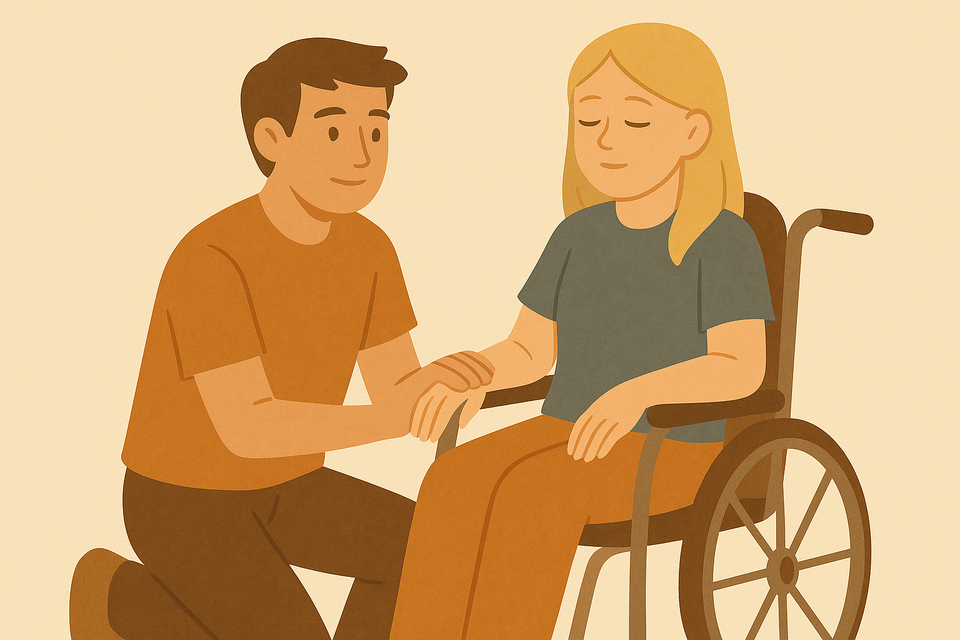
Overall, I relied entirely on my loved ones for more than a year. They took care of my cat, cleaned the house, did the grocery shopping, cooked (often preparing specific meals for me), went to the pharmacy… and at my worst, they had to help me with personal hygiene and push my wheelchair.

Learning to let go and trust others to take care of everything was extremely difficult for me, as my sense of safety had always been rooted in hyper-control. I had to accept that I was allowed to ask for help, for the first time in my life.
Loss of independence is extremely difficult, physically and emotionally, for both patients and caregivers. So, here are a few tips that helped us.
II- General tips
1- This situation is hard, like... really hard
Chronic illness puts everyone under immense pressure. ME/CFS is especially difficult. It is one of the illnesses associated with the lowest quality of life, and it can severely disable young and healthy people out of nowhere.
Most caregivers never chose this role, and most patients never expected to need help so young. It just happens, and no one is truly ready for this. So just be gentle with yourself.
2- The illness will affect the relationships
Long-term illness can strain any relationship. Finding a new balance is difficult, takes time, patience, and a lot of open communication.
It was definitely hard for me and my loved ones. We struggled, we made mistakes, and eventually we found routines that worked okay-ish. Knowing this early can prevent a lot of silent resentment.
3- Loved ones as caregivers are a double-edged sword
When caregivers are people you love (not professionals), emotions run high. Worry, fear and the urge to "fix" things can increase stress for everyone.
But even in the hardest moments, safe human presence can be invaluable for nervous system health. It's all about finding balance.
You also don't have to carry this alone. If you can, even asking for minimal outside support (from friends, family, or professionals) can make a real difference.
4- About online support groups
There are a lot of online support groups for ME/CFS and Long Covid. I've noticed that many of these spaces are dominated by despair, catastrophic narratives, and very graphic descriptions of suffering.
While this pain is real and understandable, spending too much time there was not helpful for me or my caregivers. I chose to only join groups that believed in recovery (this group is the one that helped me the most), because protecting that belief was incredibly important for me.
5- Avoid reinfections during recovery
Reinfections can delay recovery or make things worse. There are simples things you can do to reduce the risk:
- Ventilating rooms several times a day,
- Wearing FFP2 masks,
- Using air purifiers with HEPA filters if your budget allows (I personally use two from the brand Coway).
III- Tips for patients
1- You are allowed to ask for help
Asking for help is not easy, I know. But it does not mean you are weak or a burden! Needing support during illness IS normal. You deserve care.
2- Communicate your needs clearly
Don't wait for others to guess what you need. I did this for a long time and ended up feeling resentful most of the time.
Ask directly, and be specific. For example:
- If practical tasks feel too exhausting, ask for concrete support, like help with a meal, laundry, or a pharmacy run.
- If you need rest with no stimulation, ask to be left alone and to reduce noise in the house as much as possible.
- If you need company but feel exhausted, ask for quiet presence.
3- Find energy-efficient ways to communicate
I often communicated with my caregivers by dictating messages to my phone and using voice commands.
When I started feeling a little bit better, I found quick phone calls more helpful than writing when trying to communicate important things clearly.
I also let my loved ones know in advance that I preferred to be the one to initiate contact, in order to choose times when I felt able to communicate.
4- How to communicate your state and fluctuations
As our condition fluctuates a lot, caregivers may feel a bit lost or taken aback during visits: one day you seem to be doing relatively well, and the next day, you can barely speak, with very different needs.
First, let your caregivers know that fluctuations, sometimes significant, are to be expected.
Then, it can be helpful to share how you're doing ahead of each visit, but going into detailed symptom descriptions can quickly become stressful for everyone.
With my mom, I tried daily updates, energy scores, emojis… none of it really felt good. What helped instead was having a loose plan: set visit days and times, with the option to adjust simply when needed.
A short message like: "Hi, would you mind coming tomorrow instead? I need to rest today. Thank you." is often enough. The plan is already set, no explanations or apologies required.
5- Explain your recovery approach
Sharing your recovery plan (for me, nervous system regulation) with your caregivers can help them understand what supports you, what you are working toward, and what you want (or don't want).
Feel free to share this blog with them if you think it can help them understand what you are going through!
IV- Tips for caregivers
1- Believe your loved one, and inform yourself about their illness
I read too many stories of patients not being believed by their doctors AND by their own families. It breaks my heart. Please, always believe your loved one... It's already hard enough.
When your loved one says that noise, light, smells or touch hurt, it is not an exaggeration. With neurological illnesses, sensory stimulation can cause physical pain or symptoms.
If your loved one tells you they can't do something right now, it means they can't, not that they don't feel like it. And they are probably very sad and frustrated about it.
These illnesses have nothing to do with a lack of motivation. That is why I personally found generic advice like "Don't you want to go for a walk?" or "You should try to move more" really hard to hear.
2- You cannot fix this illness yourself
Healing from these illnesses is extraordinarily difficult, long, complex, and it is not your job as a caregiver. Being present, listening, believing, and offering steady support already matters immensely.
3- Offer empathy and realistic hope
You don't need to be relentlessly positive. Don't dismiss the suffering. But offering calm reassurance and gentle optimism can help regulate the nervous system on both sides.
Believing that recovery was possible, and being surrounded by people who believed it too, was one of the most important factors in my healing. Even in the darkest moments, we chose to protect that belief together.
Celebrate small wins together. Acknowledging tiny victories is very encouraging for everyone.
One day, it had snowed outside. I love snow, but I was completely bedridden and unable to walk. My partner came into my room holding a small bucket with a ball of snow inside, just to surprise me.
It may seem insignificant, but it wasn't. It meant the world to me, and it brightened my entire day. Tiny things matter.
4- Ask, don't guess
Ask your loved one what they need or think.
Guessing needs almost always leads to frustration on both sides, especially when energy is very limited.
Don't take emotional distance personally. Long Covid and ME/CFS deeply disrupt the nervous system. Emotional flatness or disconnection is common for patients, and it is rarely about you. If you are unsure, just ask.
5- Respect variations in capacity
Recovery from these illnesses comes with ups and downs, and is often very slow.
Your loved one may be able to do an activity one day, and not the next, even if it doesn't make sense from the outside. Capacity to tolerate sensory stimulation (noise, light, agitation, stress) can also change and drop rapidly.
When symptoms increase a lot, rest, calm and space are part of the treatment. Providing some hope and reassurance is also especially important during those temporary setbacks.
6- Take on part of the mental load
Planning, organizing, and constantly asking for help from bed is exhausting. When possible, another person taking initiative can be a huge relief.
You can also offer support during medical appointments. Many patients are not believed by the medical community. Having someone present to support, advocate, and describe daily reality can make a real difference... sadly, especially for women.
7- One VERY important final tip
Take care of yourself too.
- As a caregiver, your own exhaustion and emotions are valid. This is an incredibly difficult situation to be in, and caregivers often feel really powerless.
- Ask for help if you need some.
- You can also consider a few therapy sessions for yourself, maybe with a therapist who knows about chronic illness.
- Get your mind off the situation regularly by staying in touch with your own friends and family, and arrange times for your own activities.
V- A word about pets 🐶 🐱 🐰
Pets can be a wonderful source of emotional support... but they can also be a source of stress. So I don't think adopting a new pet during illness (especially in the early stages) is a good idea, as you need to be stable enough to care for them in all circumstances.
I already had my cat before I got sick, and it was very hard to be unable to be there for her. But in the later stages of recovery, reconnecting with her helped me a lot!

Conclusion
I want to thank my partner and my mom from the bottom of my heart. I don't know how I would have survived all of this without them.
If you are a patient reading this: I've been where you are. I know this is hard. You deserve love, care, and support. You are allowed to let go of all the pressure. Hang in there, there will be better days.
I also know that some people go through these illnesses completely alone. This reality is particularly unfair and painful.
If you are a caregiver reading this: When you feel overwhelmed, remember that this role is incredibly hard. It is normal to struggle. Doing your best is already enough. Thank you for taking care of your loved one living with ME/CFS or Long Covid.
🖤
Comments